Home Addition Permits: What You Need and Costs
Home addition permits cost $500–$2,500 and take 1–8 weeks to approve. Learn what permits are required, what inspections to expect, and why skipping them is a serious mistake.
Quick Answer: Almost every home addition requires a building permit. Permit fees average $500–$2,500 depending on project size and jurisdiction. Expect 1–8 weeks for permit approval, with multiple inspections required during construction. Skipping permits creates serious legal, financial, and safety risks.
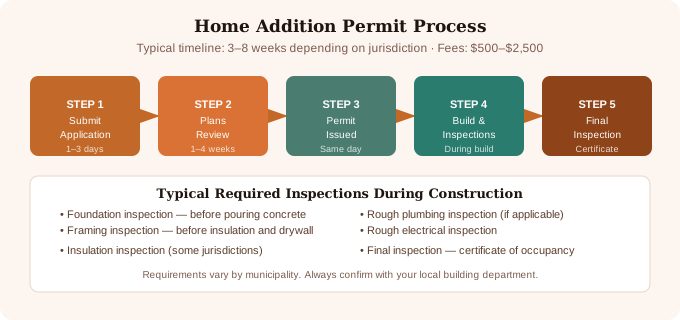
Building permits are one of the most misunderstood parts of home addition projects. Homeowners frequently see them as a bureaucratic burden and a cost to minimize. The reality is different, permits protect you legally, ensure the work is done safely, and protect your home's value at resale. Our home addition cost calculator includes permit costs in every estimate (approximately 7.5% of the base construction cost) because they're non-negotiable on any legitimate project.
What Permits Are Required for a Home Addition?
For virtually every home addition in the United States, you'll need at minimum a building permit. Depending on what's in the addition, you may also need:
- Electrical permit, required whenever new circuits, panels, or wiring are added (almost always)
- Plumbing permit, required for any new supply lines, drain lines, or fixtures
- Mechanical permit, required if you're extending HVAC ductwork or adding a new system
- Zoning approval, required if your addition triggers any zoning variance (e.g., it encroaches closer to a property line than normally allowed)
These are typically separate permits issued by different departments, although many jurisdictions combine them under a single "homeowner permit" application.
How Much Do Permits Cost?
Permit fees vary significantly by jurisdiction and project value. Most municipalities base fees on either:
- Project valuation, typically 0.5–2% of the estimated construction cost
- Fixed fee schedule, a flat rate based on addition type and size
- Per-square-foot fee, $1–$5 per sqft of new construction
For a $60,000 room addition:
- Low-cost jurisdiction: $500–$800
- Average jurisdiction: $1,000–$1,800
- High-cost jurisdiction (major cities): $2,000–$3,500
Add inspection fees separately, typically $75–$200 per inspection visit, with 3–6 inspections required for a typical addition.
The Step-by-Step Permit Process
Step 1: Pre-application research (before spending money) Before submitting anything, call your local building department and ask:
- What permits are required for a [X type] addition of approximately [Y sqft]?
- What documents are required with the application?
- Are there zoning restrictions I should verify first?
- What are the current approval timelines?
This call takes 15 minutes and saves enormous headaches later. Many jurisdictions have this information on their website; some don't.
Step 2: Plan preparation You'll need construction drawings. Requirements vary:
- Simple additions in lenient jurisdictions: Hand-drawn sketches showing dimensions, materials, and site plan may be acceptable
- Most jurisdictions: Drawings showing floor plan, elevations, cross-sections, structural details, and electrical/plumbing schematics
- Complex additions or second stories: Licensed architect or structural engineer stamps often required
If your contractor draws plans, verify they're in a format your jurisdiction accepts. Not all municipalities accept CAD drawings without a professional stamp.
Step 3: Application submission Submit your application with:
- Completed permit application form
- Construction drawings (two sets, often)
- Site plan showing addition location relative to property lines
- Permit fee payment
Many jurisdictions now accept online submissions. Others still require in-person visits. Timeline from submission to approval:
- Small jurisdictions with light workload: 1–2 weeks
- Average municipality: 2–4 weeks
- Large cities (NYC, LA, Chicago): 4–12 weeks for complex projects
Step 4: Inspections during construction This is where most homeowners are surprised. Permits don't just cover the finished product, inspectors need to see the work at multiple stages:
- Foundation inspection, before concrete is poured, inspector verifies footing depth, width, and rebar placement
- Framing inspection, after walls and roof are framed but before insulation, inspector verifies structural integrity, header sizing, and connections
- Rough electrical inspection, before drywall, inspector verifies wire routing, box locations, and ground fault protection
- Rough plumbing inspection (if applicable), before walls close, inspector verifies proper pipe sizing, slope, and venting
- Insulation inspection (some jurisdictions), verifies proper R-value and installation
- Final inspection, completed addition, all systems operational; inspector issues a certificate of occupancy
Schedule inspections early. In busy jurisdictions, inspection wait times can run 1–3 weeks. If you close up walls without an approved inspection, you may be required to open them again.
Step 5: Certificate of occupancy After passing the final inspection, you receive a certificate of occupancy (CO) for the new space. This document is important, keep it with your property records. Lenders, buyers, and insurers may ask for it.
The Consequences of Skipping Permits
Some contractors suggest skipping permits to save time and money. Don't do it. The risks far outweigh the cost savings:
Retroactive permitting and remediation: Many jurisdictions allow "retroactive" permits for unpermitted work, but they require the work to be inspected after the fact. That often means opening up walls, re-running wiring or plumbing to current code, and paying a penalty fee on top of the permit cost. Total retroactive permitting cost: $3,000–$25,000+.
Home sale complications: Savvy buyers and their agents always check permit history. An unpermitted addition surfaces on a title search or home inspection. Some lenders won't finance a home with unpermitted additions. At best, you'll need to disclose it and reduce your asking price. At worst, the deal falls apart.
Homeowner's insurance: If an unpermitted structure sustains fire or water damage, your insurance company may deny the claim on the grounds that the structure wasn't permitted. This is not hypothetical, it happens.
Safety: The inspection process exists because structural and electrical failures cause deaths. A framing inspection that catches undersized headers or an electrical inspection that catches overloaded circuits is worth far more than the inspection fee.
Zoning Setbacks and Variances
Before designing your addition, verify the zoning setback requirements for your parcel. Most residential zones require:
- Side yard setback: 5–10 feet from the property line
- Rear yard setback: 15–25 feet from the rear property line
- Front yard setback: Varies significantly
If your planned addition would violate any setback, you'll need a zoning variance, a formal application requesting an exception. Variance applications involve:
- Filing fees ($200–$1,000)
- A public notice requirement (neighbors are notified)
- A hearing before the zoning board (typically 4–8 weeks wait)
- Board approval (not guaranteed)
Plan around setbacks whenever possible. Variances add time, cost, and uncertainty to the project.
HOA Approval
If you live in a community with a homeowners association, your addition likely requires HOA approval before or concurrent with the permit application. HOA approval timelines and requirements vary wildly. Some HOAs respond in 2 weeks; others have quarterly board meetings. Factor this into your project timeline.
Working With Your Contractor on Permits
A reputable general contractor will:
- Pull all required permits in their name (as the licensed contractor of record)
- Schedule all required inspections
- Be on-site or available during inspections
- Provide you with copies of all permits and inspection approvals
Be very cautious about any contractor who suggests skipping permits or asks you to pull the permits yourself. Pulling a permit as the homeowner (called an "owner-builder" permit) means you are assuming legal responsibility for code compliance. If you later sell the home, buyers may require a licensed contractor inspection of all owner-builder work.
For a complete picture of home addition costs including permits, use our home addition cost estimator. And when you're ready to plan your full project budget, our home addition cost breakdown covers all the major cost categories.