DIY vs Contractor for Home Additions: Real Costs
DIY home additions can save 30–40% on labor, but come with permit, structural, and quality risks most homeowners underestimate. Here's the honest comparison.
Quick Answer: DIY home additions save 30–40% on labor (typically $15,000–$30,000 on a $60,000 project), but require substantial construction skill, expose you to permit complexity, eliminate contractor liability protection, and dramatically extend the timeline. Most homeowners are better served by hiring a licensed general contractor for structural work.
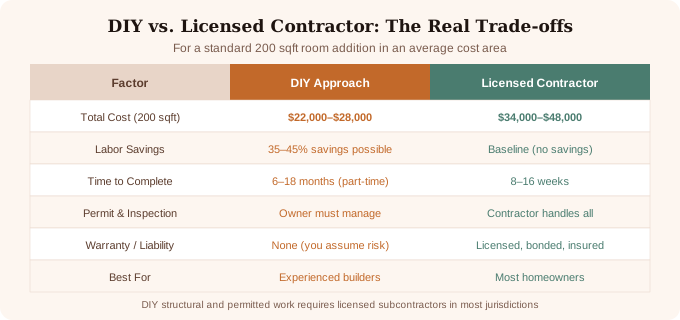
The appeal of DIY home additions is easy to understand. A 200 sqft standard room addition might cost $40,000–$55,000 with a general contractor. The materials alone, framing lumber, insulation, drywall, roofing, windows, flooring, might run $18,000–$25,000. That gap represents labor cost, and it's real money.
But there's a version of DIY that works and a version that doesn't. This guide draws the line clearly, using our home addition cost calculator as a baseline.
What DIY Actually Saves
On a 200 sqft room addition, a licensed general contractor typically charges:
- Project management fee: 10–20% of total project cost ($4,000–$11,000)
- Subcontractor markup: 15–25% over what you'd pay subs directly ($3,000–$8,000)
- Labor for self-performed work: Framing, drywall, finish carpentry ($6,000–$14,000)
Total potential savings from managing the project yourself and doing some labor: $13,000–$33,000 on a $55,000 project. That's real.
But those savings assume you can:
- Effectively manage multiple subcontractors (framer, roofer, electrician, HVAC, finish carpenter)
- Handle permits and scheduling inspections
- Troubleshoot problems that arise during construction
- Spend 20–40 hours per week for 4–6 months managing the project
Running a construction project is a full-time job. If you have that time, the background knowledge, and the stomach for it, owner-managed additions can work.
What You Cannot DIY
In most jurisdictions, the following work must be performed by licensed professionals regardless of your skill level:
Electrical work. In most states, homeowners can perform their own electrical work in their own residence, but the work must pass inspection. In practice, few homeowners without electrical training can correctly size circuits, install a subpanel, and get a rough electrical inspection to pass without expensive corrections. Licensed electricians charge $75–$150/hour, but they get it right the first time.
Plumbing. Many states require a licensed plumber for any new drain, vent, or supply line installation, even in owner-occupied residences. The inspection process for rough plumbing is rigorous. Improperly sloped drains (must be 1/4" per foot) or missing P-traps fail immediately.
Structural work in permit jurisdictions. Your building department needs a plan signed by a licensed designer or structural engineer if the addition requires engineering calculations. A general framer can build what's on the plans, but someone must produce the plans.
Second story structural work. Do not DIY the structural reinforcement for a second story addition without engineering supervision. This is a category where the failure mode is catastrophic.
The Three DIY Approaches (and Their Risk Levels)
Approach 1: Full DIY (you do all the work) For experienced builders only. You're handling framing, roofing, drywall, insulation, electrical, plumbing, and finish work. Timeline: 12–24 months for a 200 sqft addition done on weekends.
Risk level: High. Most homeowners who attempt this underestimate the complexity of roofing integration, plumbing venting, and electrical load calculations. The most common result is a project that stalls at rough framing for months, then gets finished by a contractor at significant cost to correct errors.
Approach 2: Owner-Builder with Licensed Subs You pull the permits as owner-builder, hire licensed subcontractors for electrical and plumbing, and do the framing and finish work yourself. Timeline: 4–8 months.
Risk level: Moderate. This is the approach most realistic for skilled homeowners. You coordinate scheduling, do the non-licensed labor yourself, and hire out the code-critical work. The main risks are scheduling delays (licensed subs aren't always available on your timeline) and inspection complications.
Approach 3: Owner's Representative with GC for Structure You hire a general contractor for the structural work (foundation, framing, roofing) and manage finish work (painting, flooring, trim) yourself. Timeline: 3–5 months.
Risk level: Low. This is the most practical hybrid approach for most homeowners. You capture labor savings on finish work (typically 15–20% of total cost) without taking on the high-stakes structural and mechanical work.
Permits and the Owner-Builder Route
As an owner-builder, you can pull permits in your own name in most states. This works, but it comes with significant strings attached:
- You are legally responsible for code compliance, even if a subcontractor does the work
- Disclosure at sale: In many states, homes with owner-builder permitted work must disclose this to buyers. Some buyers and their lenders are wary of owner-builder work
- Future liability: If your unpermitted or improperly permitted work causes damage or injury years later, you bear the liability
A licensed general contractor's permit also provides a warranty: if work fails and was permitted by a licensed contractor, you typically have recourse through their license bond and insurance. Owner-builder work has no such backstop.
Timeline Reality Check
A licensed general contractor completes a 200 sqft room addition in 8–16 weeks. That's from breaking ground to final walk-through.
A skilled, motivated DIYer doing the same addition part-time (weekends, evenings) realistically takes 10–20 months. During that time:
- Your home has an open construction zone
- Materials sitting uncovered are exposed to weather damage
- Your timeline is at the mercy of permit scheduling and sub availability
If you have a firm deadline, a new baby coming, an elderly parent moving in, DIY timelines create serious stress.
Making the Decision
DIY makes sense if:
- You have construction experience (framing, roofing, drywall), not just home repair experience
- You're comfortable with permit applications and inspection scheduling
- You have 15–25 hours per week available for 6+ months
- You're doing finish work only (painting, flooring, trim) on a GC-completed structure
Hire a contractor if:
- The addition involves structural work (any second story, any work modifying load-bearing walls)
- You need the project done in a predictable timeframe
- You want warranty protection and liability coverage
- You haven't framed a room or hung drywall before
Before deciding, get a contractor bid first. Use our home addition cost estimator to establish a baseline, then compare that estimate to what you'd actually save by doing work yourself. Sometimes the gap is smaller than expected after accounting for tool purchases, material waste, and the time cost of your labor.
And for a broader look at what can go wrong when cutting corners on home additions, our 7 costly mistakes guide covers the most expensive errors homeowners make, many of which happen more frequently on DIY or poorly supervised projects.