7 Costly Home Addition Mistakes to Avoid in 2026
These 7 home addition mistakes cost homeowners thousands. From skipping permits to hiring unlicensed contractors, learn what to avoid before you start.
Quick Answer: The most costly home addition mistakes are skipping permits, hiring unlicensed contractors, not budgeting a contingency fund, only getting one bid, ignoring HOA restrictions, undersizing, and skipping structural engineering for second stories. Any one of these can add $5,000–$50,000 to your final cost.
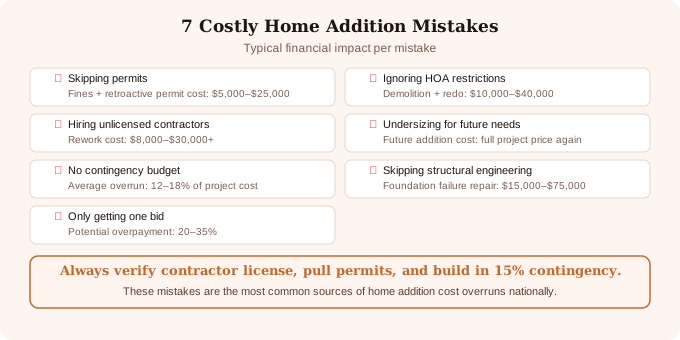
Home additions are complex projects with a lot of moving parts, contractors, permits, inspections, financing, and design decisions that are difficult to reverse once construction begins. The mistakes that cost homeowners the most are almost always the ones made in the planning stage, not during construction.
Before you start, use our home addition cost calculator to establish a realistic budget. Here's what to avoid once you've done that.
Mistake 1: Skipping Permits to Save Time or Money
This is the costliest mistake, and it's more common than you'd think. Homeowners skip permits because they add cost ($500–$2,500 typically), time (2–8 weeks for approval in most jurisdictions), and inspection complexity.
The real cost of skipping permits:
- Retroactive permitting: If you sell your home, a home inspection will flag unpermitted additions. Many buyers require retroactive permitting before closing. That means opening up walls for inspection, potentially re-doing work to current code, paying a penalty permit fee, and covering the cost of inspections. Total: $3,000–$25,000 in many cases.
- Insurance claims: Unpermitted structures may be excluded from homeowner's insurance coverage. A fire or flood in an unpermitted addition could be an uncovered loss.
- Safety: Inspections catch real problems, undersized structural members, improper electrical grounding, plumbing that fails slowly over years. The inspection process exists because these failures cause deaths and property damage.
Get the permit. It's the right call every time. Our home addition permit guide explains exactly what the process looks like.
Mistake 2: Hiring an Unlicensed Contractor
The appeal is obvious: an unlicensed contractor often quotes 20–35% below a licensed one. Sometimes they do quality work. But when things go wrong, and on complex additions, something almost always needs a course correction, you have limited legal recourse.
Licensed contractors in most states:
- Must carry general liability insurance (protects your property if they damage it)
- Must carry workers' compensation (protects you if a worker is injured on your property)
- Are bonded (provides recourse if work is abandoned or substandard)
- Are licensed to pull permits (can be the contractor of record)
An unlicensed contractor typically carries none of these protections. If a worker falls off scaffolding on your property and isn't covered by workers' comp, your homeowner's insurance may be liable.
Verify license status before signing anything. In most states, you can verify a contractor's license status online through the state licensing board in about 30 seconds.
Mistake 3: No Contingency Budget
Even on well-managed, straightforward projects, something unexpected shows up. The most common surprises:
- Rot behind existing walls where the addition connects, requires replacing framing before new construction begins ($500–$5,000)
- Undersized electrical panel that can't handle the addition's load, panel upgrade costs $1,500–$3,500
- Unexpected soil conditions requiring deeper footings or piers ($2,000–$15,000)
- Asbestos or lead paint in the area being modified, remediation required by law ($1,000–$10,000)
National data from HomeAdvisor shows that home addition projects exceed initial budget estimates by an average of 12–18%. Budget 15% contingency on top of your contractor quote. If you don't use it, great, it's money still in your pocket.
Mistake 4: Getting Only One Bid
A single bid gives you no context. You don't know if you're being charged a fair rate, a premium rate, or if the scope is complete. Bids on home additions commonly vary 20–35% for the exact same project, sometimes because of genuine cost differences in overhead and labor, sometimes because one contractor left items out of scope.
The discipline of getting 3 bids forces you to:
- Write a clear scope of work (so all three are bidding the same thing)
- See the range of pricing in your local market
- Have a conversation about why bids differ, often revealing scope gaps in cheaper bids
Use our home addition cost estimator to get a ballpark number before reaching out to contractors. If all three bids come in significantly above your calculator estimate, you'll know whether you're looking at a regional cost issue or a scope issue.
Mistake 5: Ignoring HOA Restrictions
Homeowners associations have architectural review boards that must approve exterior modifications in many communities, and home additions definitely qualify. HOA restrictions commonly govern:
- Exterior materials (must match existing or approved list)
- Roofline style and pitch
- Color of siding, trim, and windows
- Maximum addition size relative to lot coverage
- Timing restrictions (no construction during certain hours or months)
Building an addition without HOA approval can result in a mandatory stop-work order, a legal dispute, and, in the worst cases, a requirement to demolish the addition. The demolition and rebuild cost is entirely on you.
Check your CC&Rs (Covenants, Conditions & Restrictions) and submit your addition plans to the HOA architectural review board before breaking ground. Budget 2–8 weeks for HOA approval, depending on how often the board meets.
Mistake 6: Building Too Small for Your Actual Needs
"We'll just add 12×12, that's 144 sqft, should be plenty." Six months after completion: "I wish we'd gone bigger."
Building an addition is expensive partly because of fixed costs that don't scale with size, permit fees, mobilization, foundation work, roofline integration. The incremental cost of going from 150 to 200 sqft is lower per square foot than the first 150 sqft. A slightly larger addition often costs only 15–25% more than a smaller one.
Think about how you'll actually use the space in 5 years, not just today. A home office that will also need to function as a guest room needs space for a daybed or murphy bed. A playroom will become a teen hangout space, will it work then? Plan for future use, not just current use.
Mistake 7: Skipping Structural Engineering for Second Stories
Second-story additions require a structural engineer's assessment in virtually every case. This is not optional, and skipping it to save $1,500–$5,000 is one of the most expensive risks you can take.
What can happen when you skip structural assessment:
- Foundation fails to support the additional load over time, causing settling, cracks, and ultimately structural damage, repair costs of $20,000–$75,000+
- First-floor framing is undersized for the second story loads, discovered mid-construction, requiring expensive reinforcement that wasn't in the contractor's bid
- Load-bearing wall is removed without proper header sizing, sagging, cracking, potential collapse risk
A licensed structural engineer charges $1,500–$5,000 to assess your existing foundation, first-floor framing, and load-bearing walls for a second story addition. That assessment either gives you the green light with confidence or identifies what reinforcement is needed, before you've committed to a $150,000 project. It's one of the highest-ROI expenses in any second-story project.
A Final Note on Budgeting
The best way to avoid mistakes is to enter any project with realistic cost expectations. Unexpected decisions become costly mistakes when homeowners are already stretched to their budget limit at the start.
Use our home addition calculator to establish your budget, then read our complete cost breakdown guide to understand every major cost category. Going in with a realistic number and a 15% contingency means that when the unexpected happens, and it will, you're prepared rather than scrambling.
For advice on navigating the contractor selection process specifically, our DIY vs. contractor comparison covers what to look for and what to avoid when hiring.