How to Finance a Home Addition: Loans and HELOCs
The best way to finance a home addition depends on your equity, project size, and timeline. Compare HELOCs, home equity loans, cash-out refinancing, and FHA 203k loans.
Quick Answer: Most homeowners finance additions under $100,000 with a HELOC or home equity loan. For additions over $100,000 or if your current mortgage rate is already low, a cash-out refinance often makes sense. FHA 203(k) loans work for buyers adding onto a home they're purchasing. Use our home addition cost calculator to get your budget before approaching lenders.
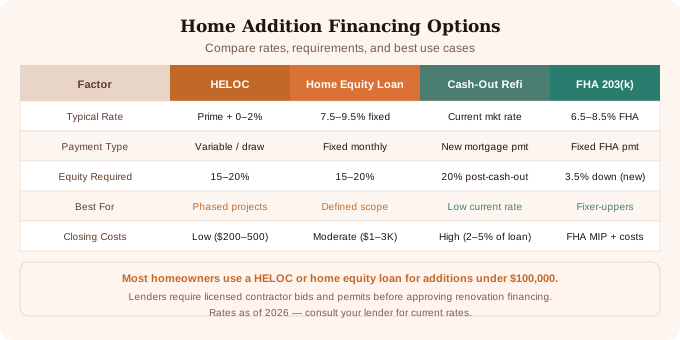
Financing a home addition requires knowing three things: how much the addition will cost, how much equity you have in your home, and which loan product fits your situation. Get a realistic cost estimate first, before talking to lenders. Our home addition cost estimator gives you a working number based on your project type, size, quality, and location.
How Much Can You Borrow?
Most lenders allow you to borrow against your home equity up to a combined loan-to-value (CLTV) of 80–90%. The math:
Your borrowing capacity: Home value × 80% − Current mortgage balance = Maximum equity line
Example: $400,000 home value × 80% = $320,000 max. If you owe $240,000 on your mortgage, you can borrow up to $80,000 against your equity.
Some lenders allow CLTV up to 90%, which would increase that to $120,000 in the example above, but at slightly higher rates.
For projects over your equity limit, a construction loan, personal loan, or cash-out refinance may be needed.
Option 1: Home Equity Line of Credit (HELOC)
A HELOC is a revolving credit line secured by your home equity. You draw funds as needed during a draw period (typically 5–10 years), then repay the outstanding balance over a repayment period (10–20 years).
Rate: Variable, typically Prime + 0–2%. As of early 2026, that puts most HELOCs at 8–10%.
Best for: Phased projects where you need funds in stages. If you're doing a 6-month addition and paying contractors in draws, a HELOC lets you borrow only what you've spent, reducing your interest cost versus taking a lump sum.
Closing costs: Low, typically $200–$500, sometimes waived by the lender.
Requirements:
- Minimum 15–20% equity after the line is opened
- Credit score typically 680+ (680–720 for standard approval, 720+ for best rates)
- Debt-to-income ratio typically under 43%
Watch out for: Variable rate exposure. If you carry a $60,000 balance and rates rise 2%, your interest cost increases by $1,200 per year. Some HELOCs offer rate conversion to fixed after the draw period.
Option 2: Home Equity Loan
A home equity loan is a lump-sum second mortgage with a fixed rate and fixed monthly payments. You receive the full amount at closing.
Rate: Fixed, typically 7.5–9.5% as of early 2026.
Best for: Additions with a well-defined scope and budget. If you know the addition will cost $65,000 and you want predictable monthly payments, a home equity loan is cleaner than a HELOC.
Closing costs: Moderate, typically $1,000–$3,000 (appraisal, origination fee, title work).
Requirements: Similar to HELOC, 15–20% equity, 680+ credit score, under 43% DTI.
Advantage over HELOC: Locked rate protects you from rising rates. Your monthly payment is fixed for the life of the loan, making budgeting easier.
A $65,000 home equity loan at 8.5% over 15 years costs approximately $640/month. At 7.5%, it's about $600/month.
Option 3: Cash-Out Refinance
A cash-out refinance replaces your existing mortgage with a new, larger mortgage. You receive the difference in cash.
Example: You owe $250,000 on a $400,000 home. A cash-out refinance at 80% LTV gives you a new $320,000 mortgage, paying off the old one and giving you $70,000 in cash.
Rate: Your new mortgage rate, currently running 6.5–8% for 30-year conventional as of early 2026.
Best for: Homeowners with high-interest existing mortgages who would benefit from refinancing anyway. If your current rate is 5% or higher and current rates aren't significantly higher, the refinance "math" works.
Not ideal for: Homeowners with a low existing mortgage rate (3–4% from 2020–2022). Trading a low-rate mortgage for a higher-rate one to extract equity is expensive over the loan term.
Closing costs: High, 2–5% of the new loan amount. A $320,000 cash-out refi costs $6,400–$16,000 in closing costs.
Real cost example: Replacing a 4% mortgage on $250,000 with a 7% mortgage on $320,000 increases your monthly payment by roughly $700–$900 per month. That's an enormous hidden cost over 20+ years compared to a HELOC or home equity loan.
Option 4: FHA 203(k) Loan
The FHA 203(k) loan program allows homebuyers to finance both the purchase of a home and renovation costs in a single mortgage. There's also a Streamline 203(k) for smaller projects ($5,000–$35,000 in renovation costs).
Rate: FHA-insured rates, typically 6.5–8.5%.
Best for: Buyers purchasing a fixer-upper property that needs an addition as part of making it livable. The 203(k) wraps renovation costs into the purchase mortgage, avoiding the need for a separate home equity product.
Minimum down payment: 3.5% of the total (purchase price + renovation budget).
Limitations:
- Must be your primary residence
- Property must be at least 1 year old
- Requires FHA-approved consultant to scope the work
- More paperwork and administrative complexity than conventional financing
- Mortgage Insurance Premium (MIP) adds cost over the loan term
What Lenders Actually Need
When you apply for home equity financing for an addition, expect to provide:
- Cost estimates: Licensed contractor bids for the planned work (2–3 bids preferred). Lenders want to see that the loan amount is tied to actual project costs.
- Home appraisal: Most lenders order an appraisal to confirm home value (you pay $400–$700). Some offer an automated valuation for smaller loan amounts.
- Permit verification: Some lenders confirm that permits are obtained for the work.
- Income documentation: W-2s or tax returns, pay stubs, bank statements.
Use our home addition cost calculator to generate a preliminary budget figure, then get contractor bids to give lenders a formal number.
Construction Draw Loans
For very large additions (second stories, major additions over $100,000), some lenders offer a construction draw loan, a short-term loan that funds the project in stages as work is completed. An inspector verifies completion of each phase before the next draw is released.
Construction draw loans convert to permanent financing (a mortgage) after construction is complete. They're more complex to set up but protect both the lender and the homeowner from paying for work that hasn't been done.
Planning Your Budget
The right financing choice starts with knowing your costs. Run your project through our home addition estimator, then add 15% contingency before applying for financing. Underfunding a construction project is one of the costliest mistakes, a project that stalls because money runs out requires expensive temporary measures to protect the partially built structure.
For context on which additions justify the financing cost, see our home addition ROI guide. And for a complete picture of total project costs by addition type, our home addition cost breakdown guide is the best starting point.