Home Addition ROI: Which Additions Add Most Value?
Home additions recoup 45–65% of their cost at resale on average. See which addition types provide the best ROI, and when the math actually works in your favor.
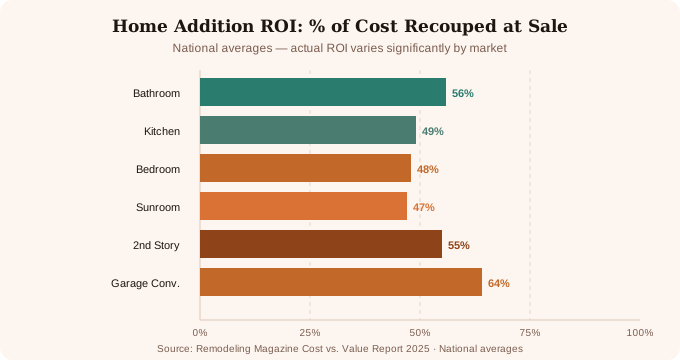
Quick Answer: Home additions recoup 45–65% of their cost at resale on average. Garage conversions, bathroom additions, and bedroom additions tend to offer the best ROI. Second stories offer strong ROI in dense urban markets. Use our home addition cost calculator to budget your project before evaluating the investment case.
Most home additions don't "pay for themselves" at resale in simple dollar terms. A $70,000 room addition that adds $42,000 to your home's value returns 60% of the cost, meaning you're out $28,000 on paper when you sell. But that's the wrong way to think about the investment. The real question is whether the addition makes financial and practical sense given how long you'll stay in the home and what the space is worth to you in daily use.
ROI by Addition Type
Based on Remodeling Magazine's Cost vs. Value Report and HomeAdvisor data:
| Addition Type | Avg. Cost (200 sqft, standard) | % Cost Recouped | Notes |
|---|---|---|---|
| Garage conversion | $26,000 | 64% | Highest ROI, low build cost |
| Bathroom addition | $45,000 | 56% | Critical in 1-bath homes |
| Second story | $110,000 | 55% | Market-dependent |
| Bedroom addition | $34,000 | 48% | Strong in undersized homes |
| Kitchen addition | $68,000 | 49% | Variable by quality |
| Sunroom | $40,000 | 47% | Limited in cold climates |
These are national averages. Actual ROI in your market may be higher or lower. In Boston, Seattle, or San Francisco, second stories often recoup 65–75% because buyers expect multi-story homes. In rural markets, a second story may recoup only 40% because buyers aren't paying a premium for vertical square footage.
When the ROI Math Actually Works
Going from 1 to 2 Bathrooms
The highest-impact bathroom addition is the first. A home with one bathroom is a functionally limited property. Families with children, households with multiple adults, and buyers expecting basic convenience all treat the bathroom count as a make-or-break factor.
Adding a second bathroom to a 1-bath home frequently adds more value than the bathroom costs. In competitive markets, a 3-bedroom, 1-bath home might sell for $30,000–$60,000 less than a comparable 3-bedroom, 2-bath home. If the bathroom addition cost $42,000, you're ahead.
This math is most powerful in markets where your home is under-bathed relative to comparable homes. If your neighborhood average is 2.5 baths and you have 1, you're leaving significant money on the table.
Adding a Bedroom in an Undersized Home
A 2-bedroom home in a neighborhood of 3-bedroom homes faces a similar valuation discount. Buyers shopping for a 3-bedroom home won't look at a 2-bedroom regardless of how attractive the price is, they're searching by bedroom count. Adding a bedroom brings the home into the most active buyer search category.
The ROI calculus: if adding a bedroom costs $38,000 and puts your home in the $400K–$450K comp range instead of the $360K–$400K range, the addition can pay for itself entirely, or more.
High-Density Urban Markets
In cities where land is scarce and the cost per square foot of existing homes is high, additions carry stronger ROI. If the average price per sqft of finished space in your neighborhood is $400, and you can add a sqft for $250 in construction cost, the math is strongly in your favor.
This dynamic is why second stories often perform well as an investment in markets like Boston, NYC suburbs, or parts of coastal California, construction costs are high, but appraised value per sqft is even higher.
Long Hold Periods
ROI analysis looks different over time. A homeowner who stays 10 years gets 10 years of use from the addition before any resale calculation. Even if the addition recoups only 50% at sale, 10 years of improved daily living quality has real value. The financial breakeven analysis also needs to account for the fact that your home's appreciation over those 10 years applies to the larger (post-addition) home value.
When the ROI Is Weak
Over-Building for the Neighborhood
"Don't out-build your neighborhood" is real estate conventional wisdom, and it has merit. If your home would be the largest, most expensive home on the block after an addition, you've likely hit the ceiling of what the neighborhood supports. Buyers in that price range will gravitate toward comparable homes in better neighborhoods.
The practical test: would your home's post-addition appraised value be within 10–15% of the most expensive comp sales in your immediate neighborhood? If not, you're at risk of building equity you can't capture at sale.
Additions That Don't Match Your Home's Style
An addition that clashes architecturally with the existing home hurts rather than helps resale value. A modern glass-and-steel sunroom on a Victorian farmhouse, or a cheap addition with mismatched rooflines, signals to buyers that the work was budget-focused. Spend the extra money to match the roofline, siding, and window style of the original structure.
High-Cost Markets with Softening Demand
The 1.6× multiplier for very high-cost markets cuts both ways. It increases your construction cost dramatically, but if the market softens before you sell, the premium you paid for the addition may not fully translate to appraised value.
The Non-Financial ROI
Home addition ROI analysis almost always underweights one major factor: the value of the space to the people who live in it.
A family that gains a home office and avoids $1,500/month in commercial lease costs recovers $18,000 per year in direct savings. A household that needed a primary bathroom suite and now has one isn't just adding resale value, they're improving their daily quality of life for years.
For real estate investors buying to flip quickly, ROI at resale is the primary metric. For owner-occupants planning to stay 5+ years, the daily use value often justifies additions that would appear marginal on a pure financial analysis.
Calculating Your Addition's Investment Case
Before committing to an addition:
- Get a realistic cost estimate. Use our home addition calculator to ballpark the cost by type, size, quality, and region. Then get 2–3 contractor bids to refine it.
- Get a pre-project appraisal opinion. Ask a local appraiser what the addition would do to your home's market value. This is not a full appraisal (no fee required), just a conversation. Appraisers know local comps and can give you a realistic sense of the value impact.
- Check neighborhood comps. Look at recent sales of homes with the addition type you're planning. Is the market paying for that feature?
- Calculate your hold period breakeven. If you stay long enough, even additions with modest ROI at sale often "pay off" through a combination of resale value increase and daily use value.
For detailed cost figures before making this decision, our home addition cost breakdown guide walks through what each addition type costs in detail. And if you're considering a second story specifically, our room addition vs. second story comparison lays out the financial and practical tradeoffs.