Kitchen Addition Cost: What to Budget in 2026
Kitchen additions cost $45,000–$150,000+ in 2026 depending on size and quality. See the full cost breakdown, what drives prices up, and how to plan your budget.
Quick Answer: A kitchen addition costs $45,000–$150,000+ for 200 sqft, depending on quality and region. Standard quality in an average market runs approximately $68,000. The biggest variables are cabinetry, appliances, and whether the addition requires plumbing from scratch. Use our home addition cost calculator to estimate your project.
A kitchen addition is one of the most complex types of home addition, and also one of the highest impact on daily life and resale value. You're adding or expanding the room that drives more home sale decisions than any other. But it's complex because a kitchen addition requires coordinating multiple specialized trades: framing, electrical (often a panel upgrade), plumbing, HVAC, and then a long list of finish trades: cabinetry, countertops, backsplash, flooring, and appliance installation.
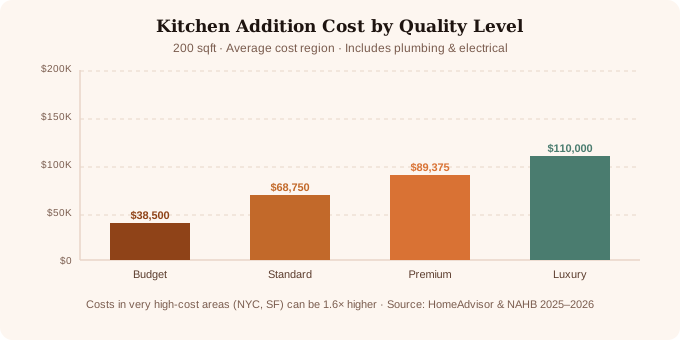
Kitchen Addition Cost by Quality Level
For a 200 sqft kitchen addition at average regional costs, with electrical and plumbing included:
| Quality Level | Estimated Cost | Cost Per Sqft |
|---|---|---|
| Budget | $38,500 | $193 |
| Standard | $68,750 | $344 |
| Premium | $89,375 | $447 |
| Luxury | $110,000+ | $550+ |
These estimates from our home addition cost calculator include foundation, permits, electrical, and plumbing. They do not include appliances (see below) or architectural design fees.
Regional multipliers matter significantly. The same standard kitchen addition that costs $68,750 in an average market costs approximately $89,000 in Boston and $110,000 in New York City or San Francisco.
What Drives Kitchen Addition Costs
Cabinetry: The Single Biggest Variable
Cabinetry typically represents 25–35% of a kitchen project's total cost. The range:
- Stock cabinets (big box store, builder-grade): $100–$300 per linear foot installed. Fastest lead time, limited customization.
- Semi-custom cabinets: $250–$600 per linear foot installed. Better quality, more options, 3–6 week lead time.
- Custom cabinets: $500–$1,200 per linear foot installed. Built to spec, any style or configuration, 8–16 week lead time.
A 200 sqft kitchen addition typically has 20–35 linear feet of cabinetry. At stock prices that's $2,000–$10,500. At custom prices it's $10,000–$42,000. That 10:1 ratio explains most of the difference between budget and luxury kitchen estimates.
Countertops
Countertops make an immediate visual impact and have a wide price range:
- Laminate (Formica): $15–$30/sqft installed. Durable, easy to clean, looks dated quickly.
- Butcher block: $30–$60/sqft installed. Warm aesthetic, requires maintenance.
- Solid surface (Corian): $40–$80/sqft installed. Seamless, repairable.
- Quartz (engineered stone): $50–$120/sqft installed. Most popular mid-range choice.
- Granite: $55–$130/sqft installed. Natural stone variation.
- Marble: $80–$200+/sqft installed. High-maintenance, premium look.
For a 200 sqft kitchen, you might have 30–50 sqft of countertop. At quartz prices, that's $1,500–$6,000. At marble, it's $2,400–$10,000.
Appliances
Appliances are typically not included in a construction budget, they're purchased separately and installed during finish work. Budget separately for:
- Budget appliance package (dishwasher, range, refrigerator): $1,500–$3,500
- Standard appliance package (good quality, matching suite): $3,500–$8,000
- Premium appliance package (KitchenAid, Bosch, Sub-Zero/Wolf): $8,000–$25,000+
Professional-grade ranges (Wolf, Thermador, Viking) alone run $3,000–$12,000. Built-in refrigerators add $5,000–$15,000.
Add appliance costs to your calculator estimate to get the full kitchen addition budget.
Plumbing Considerations
Kitchen additions require plumbing for the sink (and potentially a dishwasher and refrigerator ice maker). If the addition is adjacent to existing plumbing, extensions are straightforward.
If the addition is at a distance from existing plumbing, opposite end of the house, different floor level, running new supply and drain lines adds $3,000–$12,000 to the plumbing budget. A new dishwasher connection, disposal, and hot/cold supply with shut-offs for a simple kitchen addition runs approximately $1,800–$4,500 in materials and labor.
Electrical Requirements
Kitchens have specific electrical code requirements:
- 20-amp dedicated circuits for refrigerator, microwave, dishwasher (each separate circuit)
- 2 small appliance circuits (20-amp) for countertop outlets
- Lighting circuits for overhead and under-cabinet lighting
- GFCI protection on all countertop outlets within 6 feet of the sink
If your existing panel is at or near capacity, a panel upgrade is likely required, $1,500–$3,500 for a 100-amp upgrade to 200-amp service. This cost surprises many homeowners who didn't account for it.
Island and Peninsula
A kitchen island adds significant cost beyond the base addition estimate:
- Basic freestanding island: $1,000–$3,500 (furniture-style, not built-in)
- Built-in island with seating: $3,000–$8,000
- Island with sink and dishwasher: $6,000–$15,000 (adds second plumbing point)
- Large prep island with prep sink: $8,000–$22,000
Sample Budget Scenarios
Scenario 1: 150 sqft kitchen expansion, standard quality, average region, plumbing and electrical Our calculator estimate: approximately $52,000 (before appliances, ~$56,000–$62,000 with a standard appliance package)
Scenario 2: 250 sqft new kitchen addition, premium quality, high-cost region (Boston), plumbing and electrical, custom cabinets and quartz countertops Full project budget estimate: $140,000–$170,000 (calculator estimate ~$115,000 + premium cabinetry upgrade + appliances)
Scenario 3: 200 sqft kitchen addition, standard quality, low-cost region, plumbing and electrical Calculator estimate: approximately $55,000 (before appliances)
Try our home addition estimator with your specific inputs.
The Permit and Inspection Process for Kitchen Additions
Kitchen additions require a building permit plus separate permits for electrical and plumbing work in most jurisdictions. Plan for:
- Framing inspection
- Rough plumbing inspection (before walls close)
- Rough electrical inspection (before walls close)
- Final inspection
Work with a general contractor who routinely pulls permits for kitchen additions, the inspection schedule needs to be coordinated carefully because work must pause between inspection stages.
Financing Your Kitchen Addition
Kitchen additions are commonly financed with a HELOC or home equity loan because they're large, defined-scope projects with a known cost. A HELOC works well if you're doing phased work (cabinets and counters after construction is complete). A home equity loan at a fixed rate works better for homeowners who want a predictable monthly payment.
For a complete guide to financing options, read our home addition financing guide. And for advice on avoiding the most expensive mistakes when planning any addition, our 7 costly mistakes guide is essential reading before you start.